

What Is Cold Email?
Cold email is a one-to-one message you send to a business contact who has never heard from you. No prior relationship. No opt-in. Just a relevant message to someone who might benefit from what you offer.
We send tens of thousands of these every week for our clients. We've been running cold email campaigns since 2018. Here's what we've learned: most people confuse cold email with spam or bulk marketing. They are three very different things.
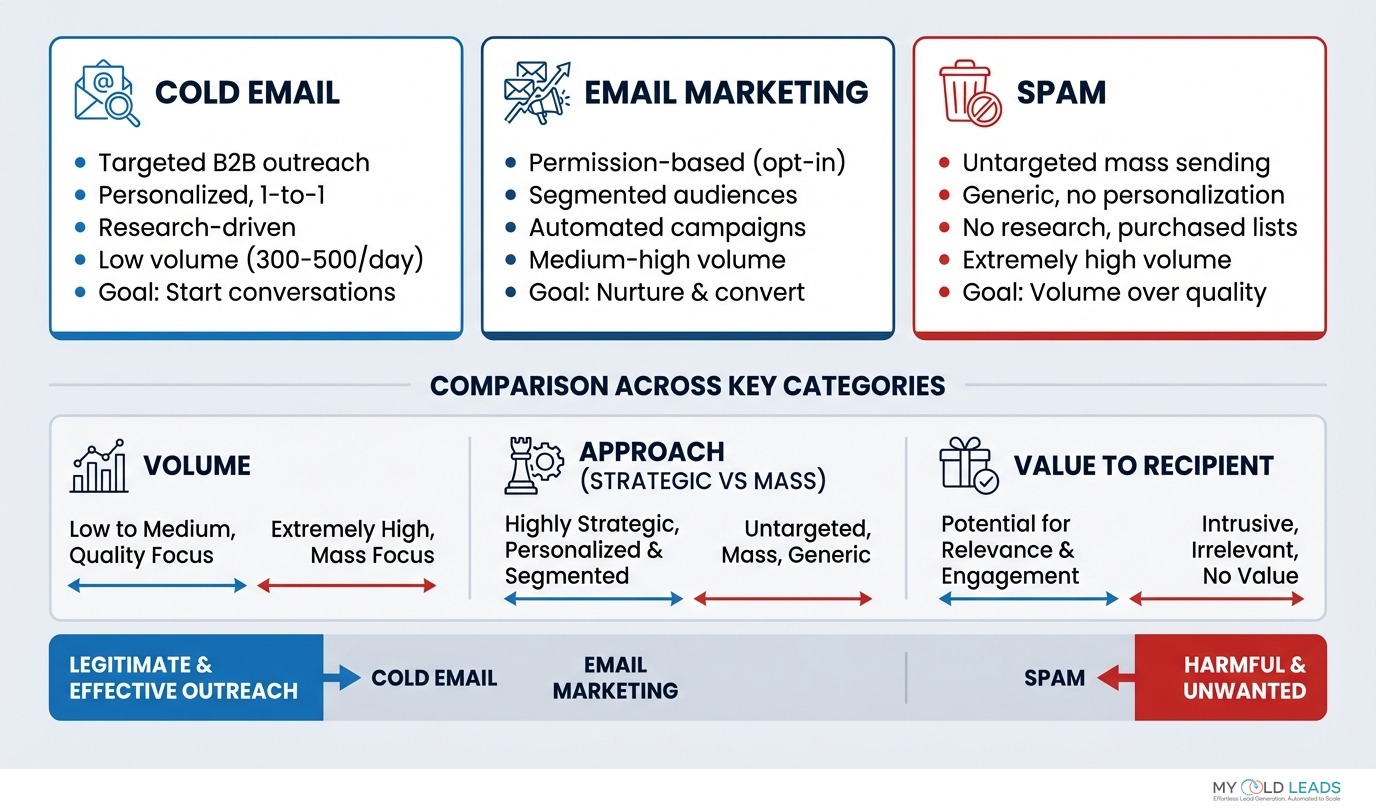
| Cold Email | Email Marketing | Spam | |
|---|---|---|---|
| Audience | Targeted individuals | Opted-in subscribers | Anyone with an inbox |
| Personalization | High - researched per prospect | Segmented, not individual | None |
| Volume | Dozens to hundreds per day | Thousands at once | Millions |
| Compliance | CAN-SPAM, GDPR aware | CAN-SPAM, GDPR compliant | Violates most regulations |
| Goal | Start a conversation | Nurture or sell to existing list | Blast and hope |
The key difference sits in that "audience" row. Cold email targets a specific person at a specific company because you believe your service could solve a problem they have. You research them first. You write something relevant to their situation. Then you send one email.
Spam skips all of that. It buys a list, writes one generic message, and blasts it to everyone.
Email marketing lives in a different world entirely. Those contacts asked to hear from you. They filled out a form or bought something. You are nurturing an existing relationship.
Cold email starts the relationship from scratch. That is what makes it hard - and what makes it valuable when done right.
If you want to see what these emails actually look like in practice, we break down real copywriting templates that have generated meetings for our clients.
The rest of this guide walks through every piece of the cold email process - from legal compliance to infrastructure to writing emails that actually get replies.
Is Cold Email Legal?
Short answer: yes, with conditions. This is not legal advice - talk to a lawyer for your specific situation. But here is how the two major frameworks treat cold B2B email.
CAN-SPAM (United States) is straightforward. You can email anyone as long as you include a physical mailing address, provide a clear opt-out mechanism, honor unsubscribe requests within 10 days, and use accurate sender information. No prior consent required. The law regulates how you send, not whether you can send.
GDPR (European Union) is murkier. GDPR does not explicitly address cold B2B email. Most companies rely on "legitimate interest" as their legal basis - the argument that contacting a relevant business contact about a relevant service constitutes a legitimate business interest. This holds up in practice, but it is debatable territory. Some EU member states have stricter local rules on top of GDPR.
We operate from Seville, serving EU and US markets. In practice, what matters most is this: be relevant, be transparent about who you are, and make it dead simple for someone to say "stop emailing me."
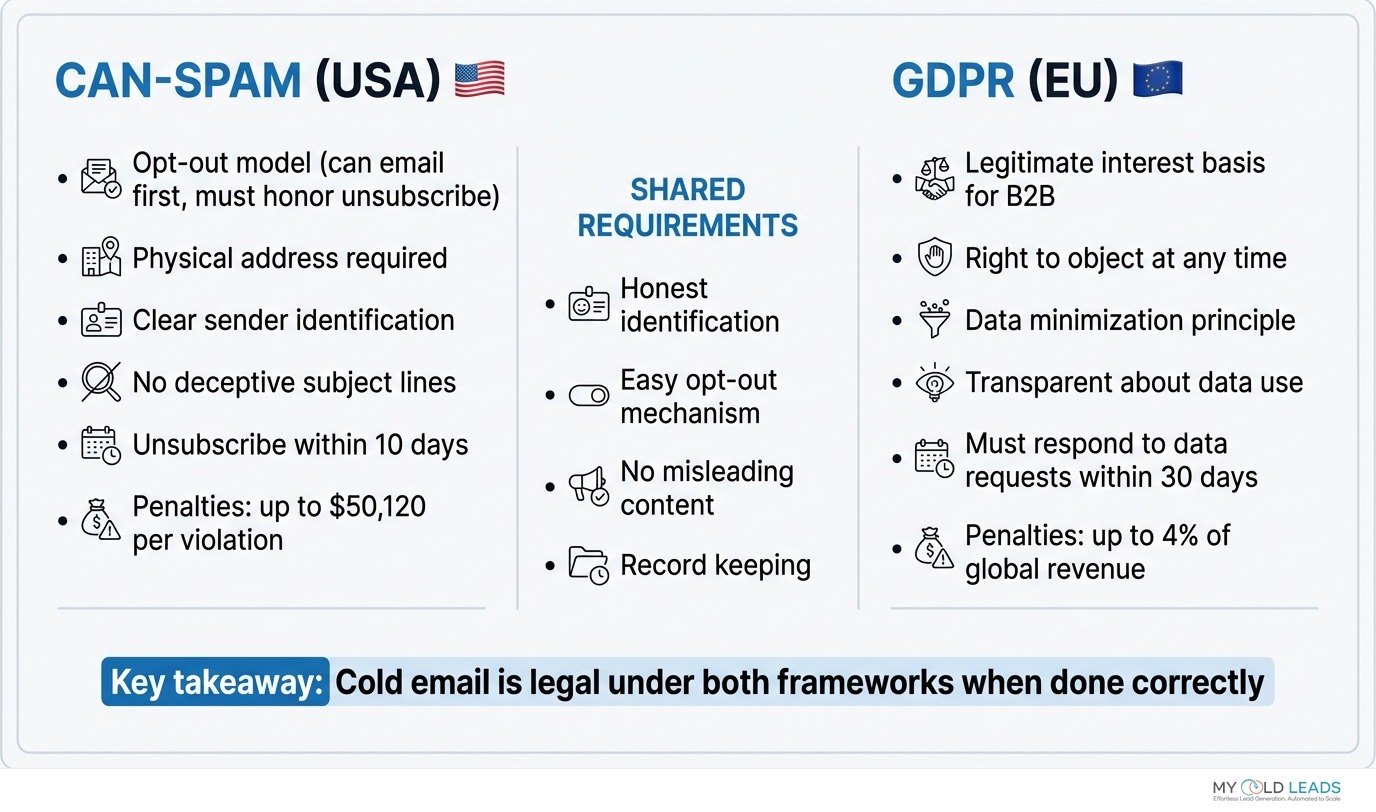
A few practical rules that keep you safe on both sides of the Atlantic:
- Include your company name and address in every email
- Never use misleading subject lines
- Add an unsubscribe option (even a simple "let me know if you'd prefer I not reach out")
- Only contact people who could plausibly benefit from your offer
- Remove anyone who asks to be removed - immediately
The companies that get in trouble are the ones sending irrelevant messages to millions of people with no opt-out. If you are sending targeted, relevant emails to small batches of researched prospects, you are operating well within the bounds of both frameworks.
Does Cold Email Still Work in 2026?
Yes. But the game changed, and most people have not caught up.
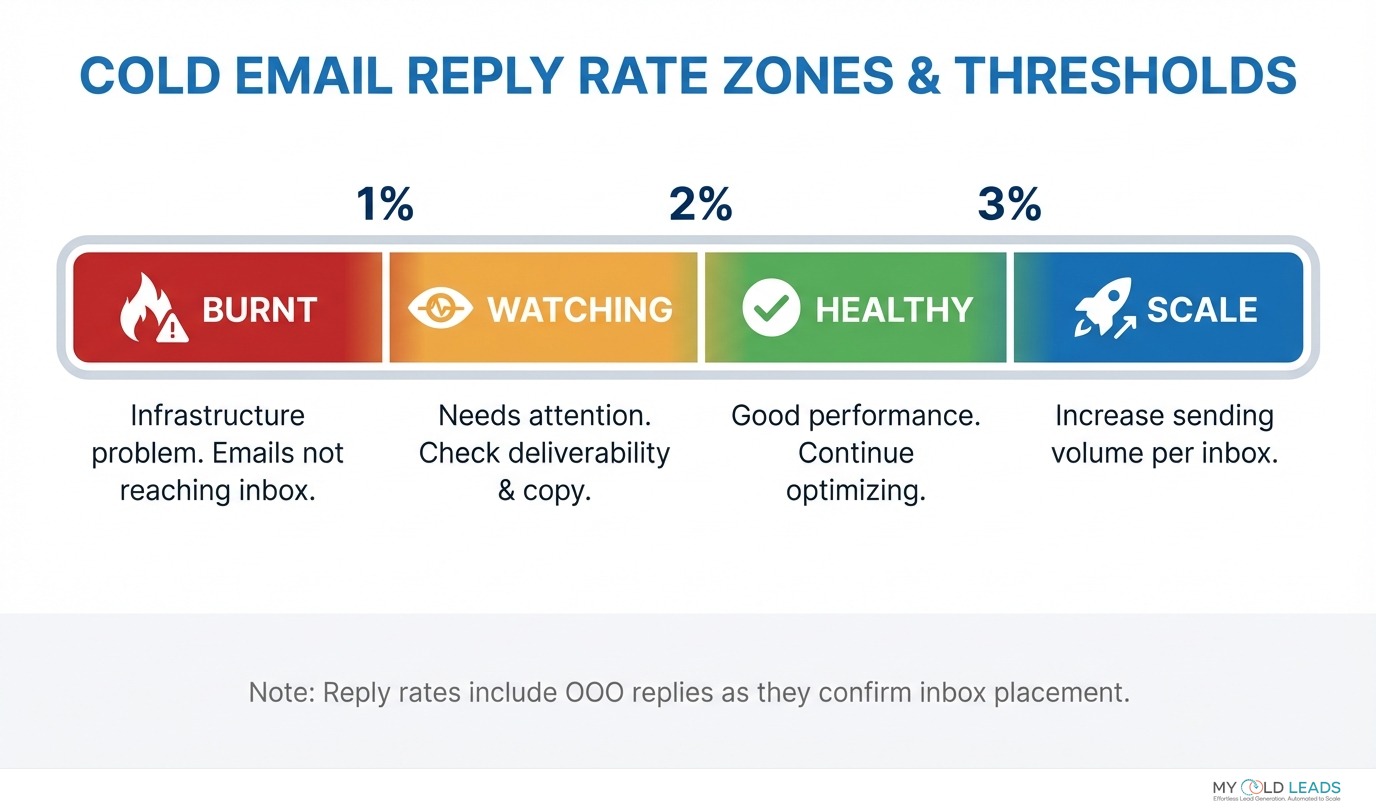
Forget open rates. Apple's Mail Privacy Protection inflated them years ago. They mean almost nothing now. Reply rates are the only metric that matters - both as a performance indicator and a deliverability signal.
Here is how we read reply rates per individual email across our client campaigns:
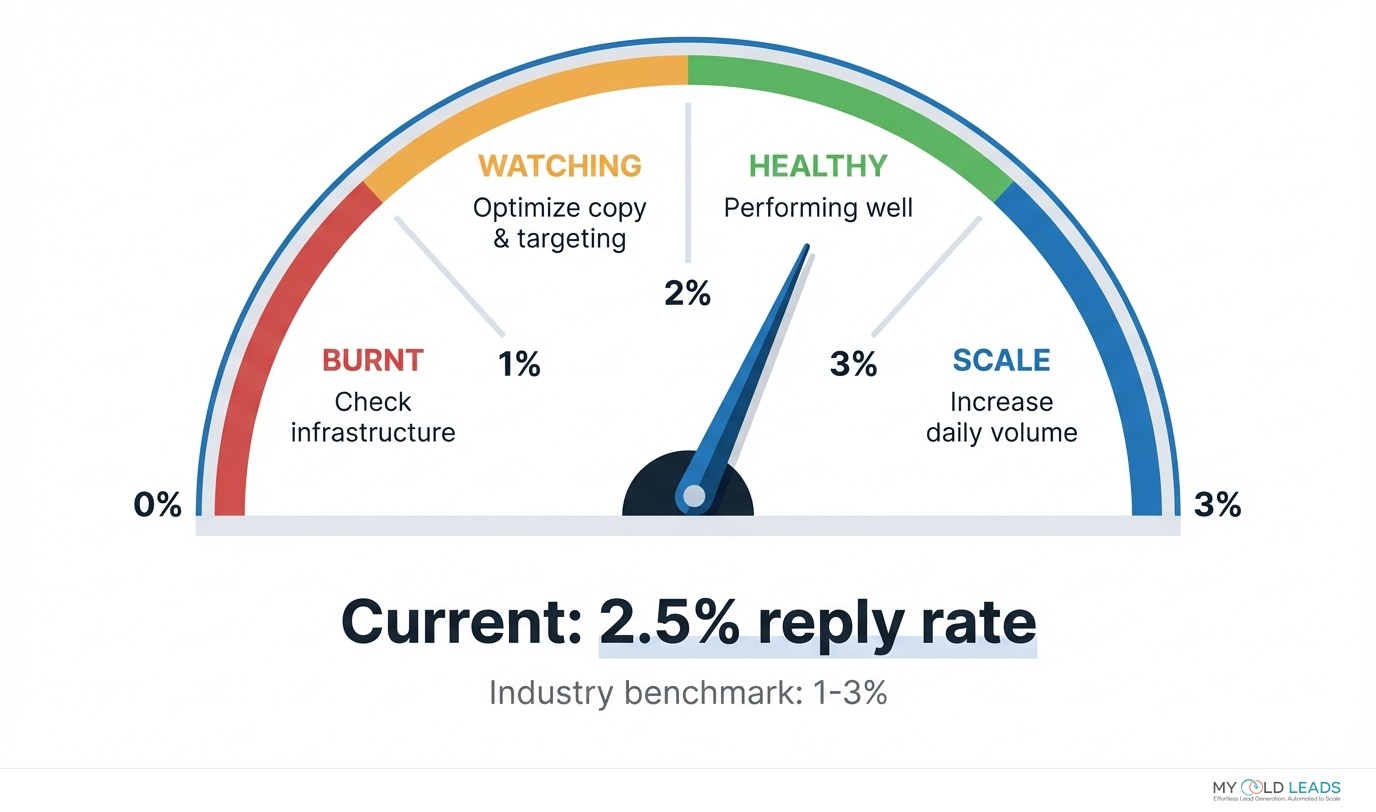
- Below 1%: Something is broken. Domain might be burnt. List might be off. Pull back immediately.
- 1-2%: Watching closely. Could be a tough market or a message that needs work.
- 2-3%: Healthy. Campaign is doing its job.
- Above 3%: Scale it. Increase the number of emails sent per inbox slightly. On Zapmail you could add more inboxes per domain, and on Hypertide you already have up to 50 per domain - in practice we just bump the daily send volume per existing inbox.
These are per-email reply rates. A full campaign with a three-email sequence will see a cumulative reply rate of roughly 3 to 12% when you add up E1, E2, and E3. Our real campaign data across sectors typically lands between 1.2% and 4% per email. Some verticals do better. Some are brutal. You will also find that certain roles - like HR Directors - seem to spend their lives out of office, and this can inflate your reply rate.
Evergreen Signal-Triggered Campaigns
There is a completely different category of cold email that most people overlook: evergreen campaigns triggered by real-time sales signals. Instead of building a list and blasting it, you detect a specific event - a company in your market announces an expansion, raises funding, hires for a new department, wins a public contract - and you reach out immediately with a message directly tied to that event.
These campaigns can produce reply rates of 15 to 30%. That is not a typo. When someone reads an email that references something they announced last week, and the offer is directly relevant to that announcement, the response rate is in a different league entirely.
Every company should have these running in the background, automated. The setup is more complex - you need monitoring systems that detect the right signals, automation that triggers personalized outreach within minutes, and templates pre-built for each signal type. But once built, they run continuously and produce the highest-quality leads in your pipeline.
Why do we include out-of-office replies in the reply rate? Because what we care about is deliverability. If we get an OOO, we know we are getting into their inbox. Out-of-office replies and "not interested" responses are good signals. A campaign with zero replies of any kind is likely hitting spam.
What the Numbers Actually Look Like
Most guides share theory. Here is real data from 10 campaigns we have run across different verticals. The metric is contacts per positive response - how many people you need to email to get one positive reply.
| Campaign | Contacts Per Positive Response |
|---|---|
| Soccer clubs (US associations) | 40 |
| Spanish teacher development (US) | 42 |
| B2B product personalization (trade fairs) | 65 |
| Dental clinic consulting | 69 |
| Private investor outreach | 76 |
| Tour operators (US/Canada) | 84 |
| Marketing services | 130 |
| HR English training | 172 |
| Industrial machinery monitoring | 329 |
| SaaS pipeline automation | 421 |
The range is enormous - 40 contacts per positive on the best campaign, 421 on the worst in this list. And we should be transparent: we have had campaigns that did not generate positive replies at all. That is the reality of cold email. If you do not get the right list, the right offer, and the right signals to create relevancy, you can have dud campaigns. Understanding this range is what lets you make smart decisions about where to invest.
The pattern is clear. Niche sectors that rarely receive cold email respond at dramatically higher rates. The soccer clubs campaign combined a compelling offer with observation-based personalization referencing each club's achievements. That produced one positive response for roughly every 40 emails sent.
At the other end, SaaS pipeline automation targeting Commercial Directors and RevOps roles was brutal. These contacts are saturated with outreach, and tech buyers tend to base decisions on their own research rather than cold emails. Even the positive responses were difficult to convert into actual meetings. Geographic variation was massive too - the US was initially unviable at 1,000+ contacts per positive, while Latin America came in around 88.
The takeaway: cold email works, but where you point it matters more than how you write it. The best copywriting in the world will not fix a saturated market. A decent email sent to an underserved niche will outperform a perfect email sent to Fortune 500 sales directors every time.
The Test Period: How We Actually Start
Given this range of outcomes, we approach every new client with a structured two-month test period. The goal is simple: find what works before committing to scale.
During the test, we throw the kitchen sink at the problem. Multiple value propositions, different ICPs, varied angles, several lead magnets. We are deliberately testing as many variables as possible to identify which combinations produce positive responses. We are transparent about this with clients - we do not know in advance which message will resonate in their specific market, so we test aggressively and let the data tell us.
The test period typically comes at a reduced price because we are investing in learning, not yet delivering at full capacity. There is no further commitment - if after two months the data shows cold email is not the right channel for their market, we say so honestly. That transparency is what builds trust, and it is why clients stay long-term once we find the formula that works.
The deliverability landscape shifted significantly. Microsoft tightened enforcement in early 2025. Google followed in late 2025. Gemini inbox launched in 2026 but only in the US market - no meaningful impact yet on B2B sending.
The biggest change is in email length. We like to keep English-language cold emails under 70 words. That constraint forces you to cut every unnecessary word, though it is not always the case that shorter wins. It is a preference informed by data, not a hard rule. People in English-speaking markets know what cold email is. They have seen every personalization trick. Relevancy and a clear offer move the needle more than clever openers.
Spanish markets are more lenient - 90 to 100 words still works fine.
If you are sending cold email without proper secondary domains, you could still get results from your primary domain. But the problem is twofold: you cannot scale it very well, and you risk everything by getting your main domain blacklisted. One bad week and your entire company email goes down with it.
How to Set Up Cold Email Infrastructure
Infrastructure is where most people fail before they even write a single email. Skip this section and nothing else in this guide matters.
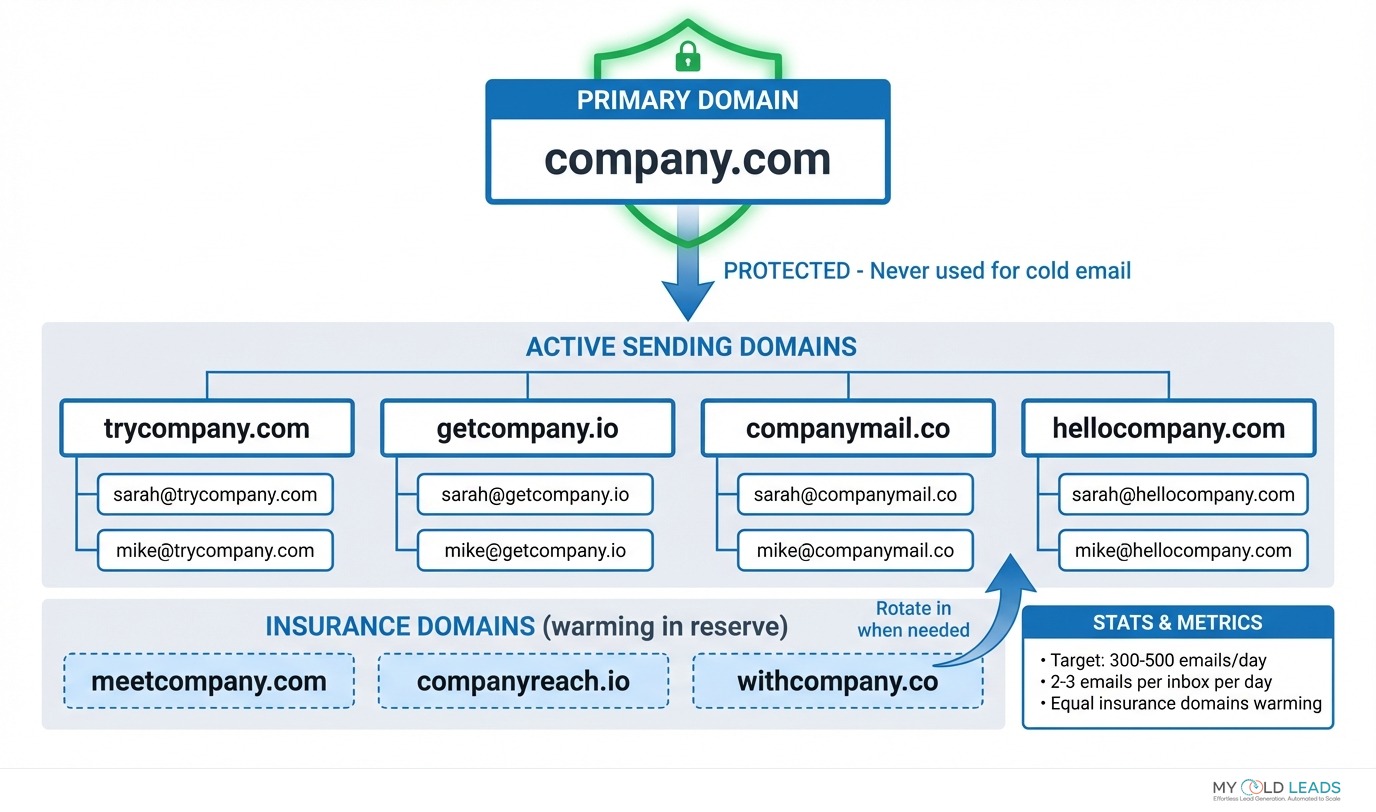
Never send cold email from your primary domain. If your company is acme.com, you do not send outreach from acme.com. You register secondary domains like acme-growth.com, getacme.com, or tryacme.com. If a sending domain gets burnt - and eventually some will - your main business email stays untouched.
We generally set up infrastructure for 300 to 500 emails per day at the beginning of an engagement. How many domains that requires depends on the infrastructure provider you use (Zapmail or Hypertide in our case - do the math based on their per-inbox limits). We also keep the same number of inboxes and domains in reserve, warming up in the background, so that when something goes wrong we can remove the burnt domain, replace it with an insurance one, and purchase new domains to replenish the insurance pool.
Choose Your Infrastructure Provider
You need mailboxes on those secondary domains. Three paths exist: Google Workspace, Microsoft 365 (via Entra), and SMTP. Specialized providers focus specifically on provisioning these inboxes for cold outreach at scale.
Which provider you choose depends on where your prospects live. The conventional wisdom is that Outlook delivers better to Outlook and Gmail to Gmail, and this does generally hold true. But when it comes to enterprise email security gateways - Proofpoint, Barracuda, Mimecast, and similar Secure Email Gateways (SEGs) - we have found Gmail to be consistently the best for inbox placement regardless of what the recipient uses.
Set Up DNS Authentication
Every secondary domain needs three DNS records configured:
- SPF - tells receiving servers which IPs can send on your behalf
- DKIM - adds a cryptographic signature to verify the email was not altered
- DMARC - tells servers what to do with emails that fail SPF or DKIM checks
These are non-negotiable. Without all three, your emails go to spam.
Warm Up Before Sending
You could technically send from an email or domain without any warmup. Let us not be naive - the big providers know when an email or domain is being used for cold outreach. The template patterns and content fingerprints are staggeringly similar across cold emailers, and ESPs are incredibly intelligent at detecting them.
That said, what we find with warmup is that it makes a domain last longer and not burn as fast. You could probably send from a domain without warming it up for a couple of weeks, but after that it will likely crash and burn. Warmup tools simulate real email activity - sending, receiving, opening, replying - to build sender reputation gradually.
We prefer a full four weeks of warmup before sending any cold email. Minimum is two weeks, but longer is always better. We have clients where we let domains warm for two to three months before launching - it depends on the domain's age, the sending volume planned, and the target market. Every domain has a different half-life, and rushing warmup is one of the fastest ways to burn a domain before it even starts producing.
One more thing on infrastructure that belongs here: set up an automation system that sends you a notification - Slack, email, whatever you use - if a domain has not received any replies for a day or two, or if your weekly reply rate drops below 1%. This is how you know to swap a domain out immediately. You can even automate the swap, replacing the burnt domain with whichever insurance domain has the longest warmup time.
Manage Sending Volume
Each mailbox sends a limited number of emails per day, and the number varies dramatically by provider. Zapmail offers Outlook and Google for Work inboxes - we typically put 2 to 3 inboxes per domain and send 15 to 20 emails per inbox per day. Hypertide has its own private IP infrastructure called "Entra", based on Azure, where we send 2 to 3 emails per inbox but with up to 50 inboxes per domain. To reach meaningful volume, you scale across multiple mailboxes rather than pushing one mailbox harder.
Infrastructure setup itself takes hours, but domain warmup needs a minimum of two weeks - preferably four or more. Not a single prospect email goes out until warmup is complete. That is the reality most people underestimate.
For a deeper walkthrough, see our guide on secondary domain setup and our roundup of outreach tools that handle this infrastructure layer.
How to Build Your Prospect List
Your list determines everything. A perfect email sent to the wrong people produces nothing. A mediocre email sent to a perfectly targeted list still books meetings.
Start with your Ideal Customer Profile (ICP). This is not "companies with 50 to 500 employees in SaaS." That is too broad. A tight ICP specifies industry, company size, specific job titles, geography, and - most importantly - a trigger or pain point that makes your offer relevant right now.
Here is a story that illustrates why ICP matters more than anything else.
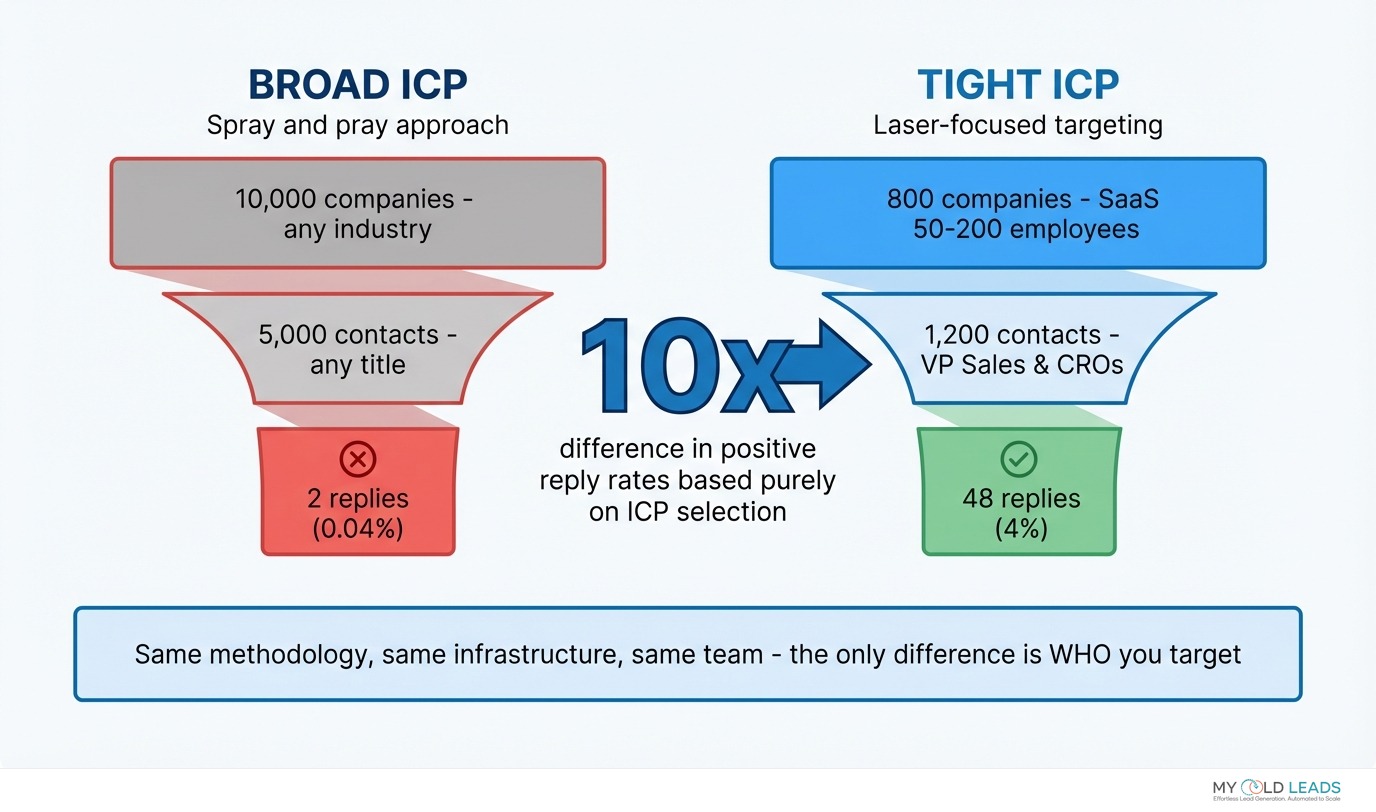
We worked with a client who runs a soccer travel program for US universities. Their first attempt cast a wide net - generic outreach to college athletic departments. It flopped. Reply rates were dismal.
We went back to the drawing board. We scraped every US soccer league and pulled the history and achievements of each club. Then we wrote observation-based outreach that referenced specific things about each program - recent tournament results, roster growth, coaching changes. The result: one positive reply for every 15 to 20 people contacted. That same campaign went from non-successful to one of our best performers.
The key insight: hitting unsaturated sectors crushes it. Fortune 500 sales directors receive dozens of cold emails per week. They are numb to personalization. They have seen "I noticed you recently..." a thousand times. But a niche sector that rarely gets cold outreach? They actually read it.
Our campaign data across 10 verticals shows a 10-50x difference in positive response rates depending on sector. The same methodology, the same infrastructure, the same team - but targeting soccer club directors instead of SaaS Commercial Directors produced radically better results. Your solution defines your sector - you cannot always choose it. But understanding how sector saturation affects your results is critical for planning volume and expectations.
Who You Contact Matters as Much as Where
Even within the same campaign, the job title you target changes everything. One industrial monitoring campaign we ran showed a CEO responding positively for every 217 contacts, a Plant Director for every 210 - but a CFO only responded for every 646. Same company list, same product, same email structure. A CFO at 646 contacts per positive is still viable - it does not mean you exclude the role. It just means your cost per meeting is higher for that title, which affects how you plan volume and budget.
Across our campaigns, CEOs tend to respond most to cold email. They have their eye on everything in their business and are constantly looking for solutions to problems that they or their team are having. They are generalists by nature - which makes them more receptive to a well-positioned cold email than a specialist who only cares about their narrow domain.
For building the actual list, we cross-reference three or more databases to maximize coverage and accuracy:
- LinkedIn Sales Navigator for finding the right people at the right companies
- Apollo for pulling contact information and company data at scale
- Clay for enrichment - adding company details, signals, and context that fuel personalization
- Public databases - we scrape government registries, trade directories, and industry-specific sources depending on the sector
- Client CRM data - when clients have existing contacts, we enrich and validate them rather than starting from scratch
- Email verification before every send - non-negotiable, never skip this step
The process that makes our lists different is AI pattern recognition on companies. We analyze 30 to 40 data points per company - employee count, revenue signals, technology stack, hiring patterns, recent news, social media activity, industry vertical, geographic expansion - and use AI to score which companies are most likely to respond. This is not just firmographic filtering. It is behavioral analysis that identifies companies showing signals of the problem our client solves.
For contacts within those companies, we work in priority tiers. P1 contacts are the primary decision-maker - the person who signs. P2 is the influencer who uses the product daily. P3 is a related stakeholder. P4 is anyone else who might forward the email. Each tier gets different messaging, and we weight sending volume toward P1 and P2.
The process flows from broad to narrow. Start with your ICP definition, then move to list building. If you are using enrichment tools, our Clay 101 guide walks through the setup. For alternative data sources, see our email prospecting guide.
How to Write Cold Emails That Get Replies
This is where most people spend all their energy - and where most advice gets it wrong. Writing cold emails is not copywriting. It is not marketing. It is starting a conversation with a stranger who is busy and skeptical.
Subject Lines and Preview Text
Keep subject lines short. Two to three words. Lowercase. Make them look like an internal email, not a promotion.
Examples that work: "quick question", "{company} growth", "idea for {first_name}".
Do not A/B test subject lines once you have one that works. Invest that testing energy into your value proposition instead. Subject lines get the open. The body gets the reply.
Preview text is becoming increasingly important. This is the snippet that appears next to the subject line in most email clients. In 2026, more prospects scan the preview text before deciding to open - especially on mobile. We use it to front-load the offer or the observation, so the prospect sees something relevant before they even click. If your subject line is "quick question" and your preview text starts with "I help companies..." you have already lost.
The Opening Line (Observation)
This is the most important sentence in your email. It determines whether someone reads the rest or hits delete.
The rule is simple: make it about them, not you. The observation line must be entirely you-focused - about the prospect's company, their situation, their challenges. Study their website. Look at their company. Find something specific you can reference.
We call these observation-based openers. They work because they prove you actually looked at the prospect's business before hitting send. We use 56 different sales triggers to identify the right signal for each prospect - everything from recent funding rounds to new hires, geographic expansion, technology changes, regulatory shifts, and competitive moves.
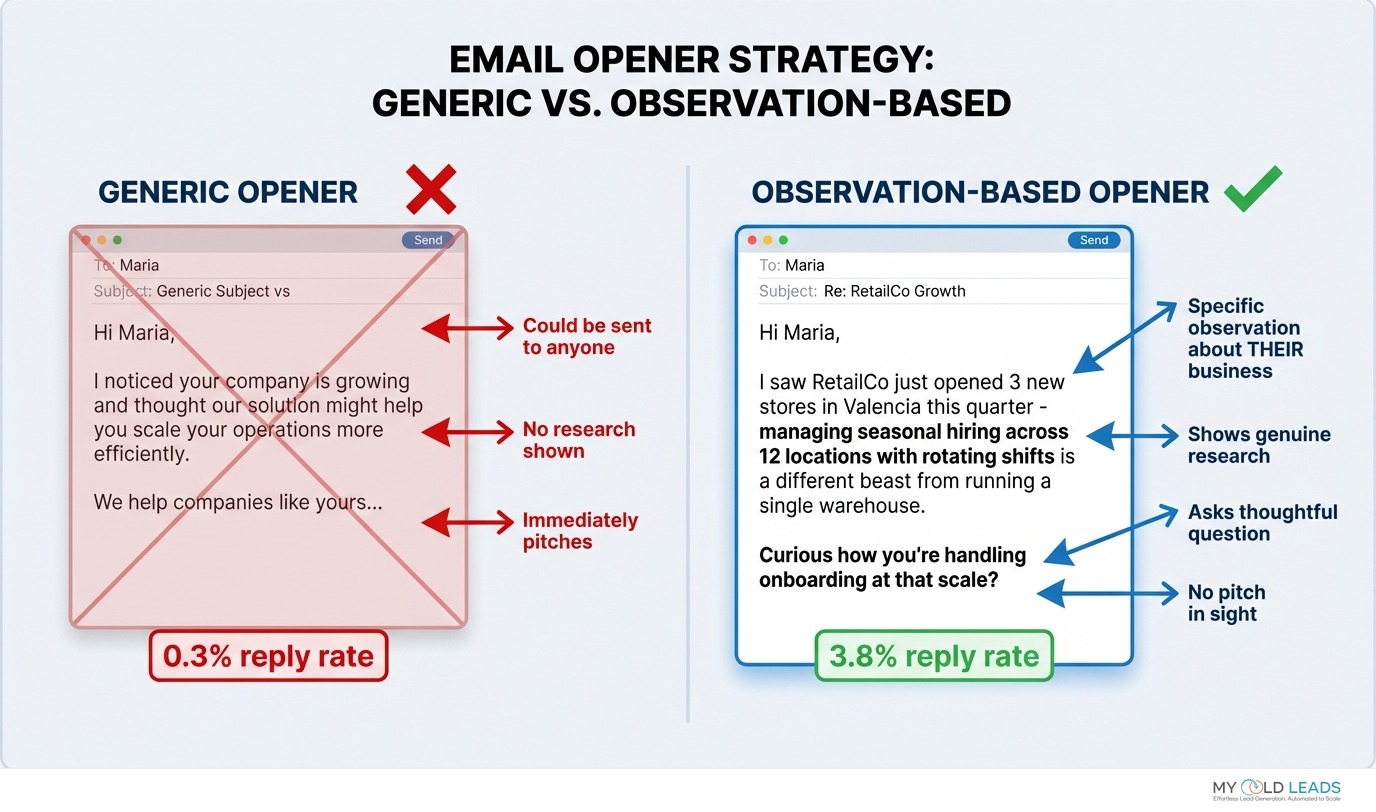
Bad: "I help companies like yours grow revenue."
Better: "Saw you opened a second location in Valencia last month - scaling retail ops with a lean team is no joke."
We take this further by using data-driven signals. For one campaign targeting dental clinics, we connected to the Google Maps API and pulled the number of competing clinics within a one-kilometer radius. The opening line became: "I see you have 18 other clinics in less than 1km - you are literally competing door to door." That kind of specificity is impossible to ignore.
For another campaign targeting US universities, we used AI to scrape thousands of university websites, cataloged every program they offered, and ran a gap analysis. The observation line highlighted what they did not offer that our client did. When a prospect reads something that specific about their own institution, the email stops looking like outreach.
Other signals we use regularly: scraping trade fair attendee lists to offer something relevant to their exhibition presence, researching a company's strategy over the last six months - acquisitions, mergers, geographic expansion, published objectives - and using those as the bridge into our solution. We also look at financial reports when available. If you are emailing a Financial Director, speak their language: "I see you are invoicing X per year - companies like yours typically see a 2 to 3% margin improvement with our solution, which for you would be roughly Y." That specificity turns a cold email into a business case.
The 56 Sales Triggers We Use
The principle is the same in every case: find a signal that proves you did real research, and lead with it. We work from a catalog of 56 sales triggers organized into seven categories: internal changes (hiring, layoffs, new executives, expansions), financial signals (revenue changes, new funding, increased spend), competitive activity (new products from competitors, agency changes), technology signals (new tools adopted, increased ad spend, website changes), market signals (new legislation, industry trends, public contracts), visibility signals (media coverage, LinkedIn activity, event attendance), and relationship signals (client reviews, provider dissatisfaction, new partnerships).
Each trigger has specific detection methods - from LinkedIn Sales Navigator alerts to Google Alerts, trade registries, government databases, and web scraping tools like Visualping and BuiltWith. The key is matching the right trigger to the right prospect so the observation line feels like a genuine insight, not a trick.
Email Body Structure
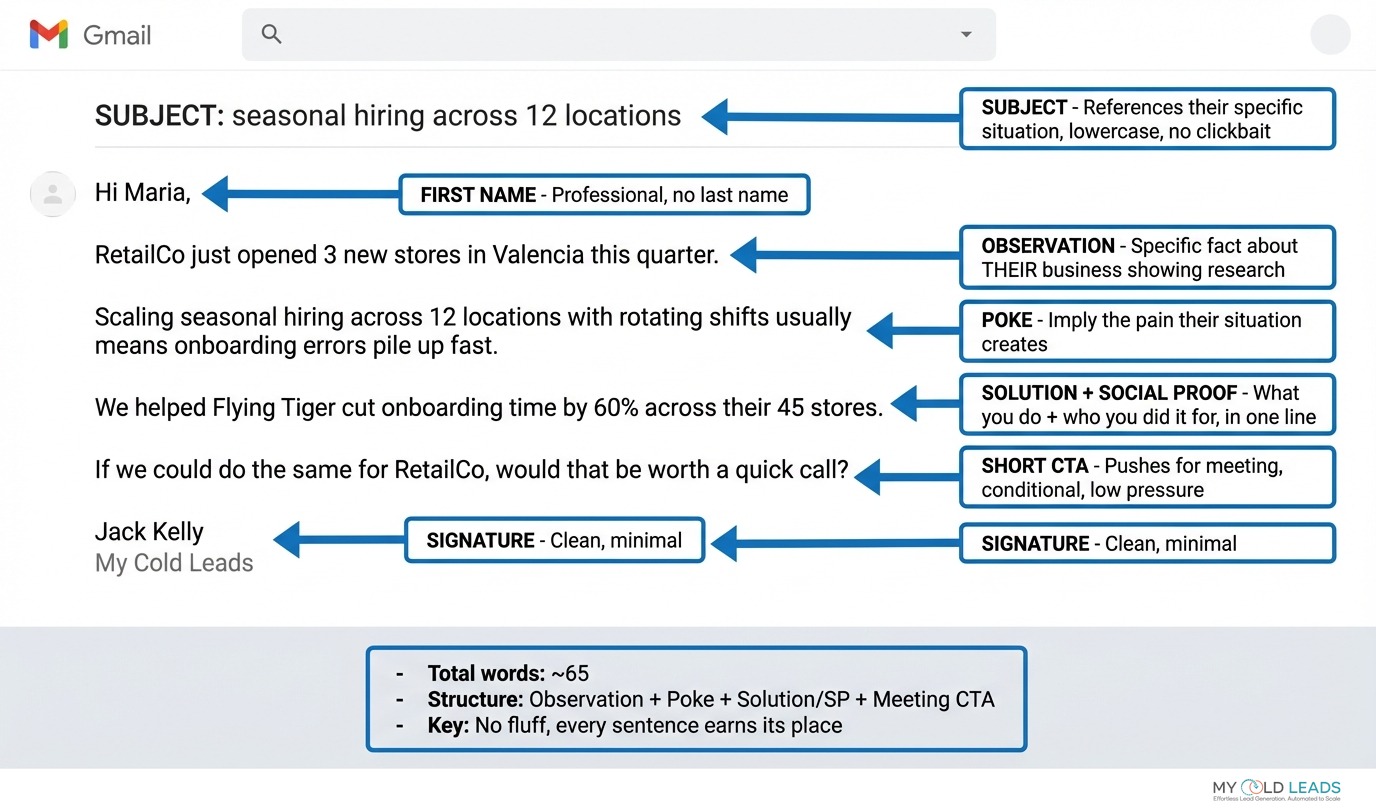
We follow a structure inspired by Josh Braun's methodology:
- Observation - something specific about their business (always about them, never about you)
- Poke the bear - agitate a problem they likely have based on the observation
- Think question - make them reflect on their own situation
- Solution hint - what solving it could look like
- Social proof - one line about a similar company you helped
- CTA - a low-friction ask
The "poke the bear" and "think question" are related but different. Poke the bear states the consequence of the problem. The think question makes them personally reflect on it. A silly example to make this stick: imagine you sell window repair. You walk past a shop with a broken window. The observation is "I see you have a cracked window on your storefront." The poke the bear is "that crack is going to spread when the temperature drops next week." The think question is "have you thought about what happens to foot traffic when customers see a damaged entrance?" The observation identifies the problem. Poke the bear makes it urgent. The think question makes it personal.
The whole thing aims for under 70 words in English. That constraint forces you to cut every unnecessary word.
The simplest emails are the best. We often find that stripping an email down to its bare essentials outperforms the clever, over-crafted version. Here is a real template structure we use:
Subject: hubspot desconectado
Hi Carlos,
I saw you integrated HubSpot with your CRM. That usually creates disconnections between marketing and sales - losing qualified leads in the handoff.
We helped TechSoluciones sync their data automatically and unify workflows between both platforms. They increased lead-to-demo conversion 43% in 6 weeks.
Would it make sense to walk you through how we did it?
Every sentence earns its place. The observation proves research. The poke the bear highlights a real consequence. The social proof is specific. The CTA is low friction. Nothing wasted.
AI-Generated Bullet Points
One of the most powerful techniques we use is generating three short bullet points per contact using AI. These bullets help the prospect imagine themselves actually using the client's solution - specific to their company, their sector, their situation.
This is not generic personalization. It is scenario painting. Here is a real example from one of our English training campaigns targeting Spanish businesses. The AI analyzes each company and generates three bullets specific to their sector and tools:
Company: SEO agency that uses Ahrefs
- We'll practice writing Ahrefs audit reports in English together
- Role-play explaining link building strategy to an international client
- Draft outreach emails in English for your guest posting campaigns
Company: Industrial manufacturer with export operations
- Negotiate supply contracts in English with your international distributors
- Present quality certifications and compliance documents to EU auditors
- Handle technical support calls from your English-speaking clients
The prospect immediately sees themselves in the scenario. These bullets are generated at scale using AI - every contact gets three unique bullets tailored to their specific company, sector, and situation.
We owe a significant debt to Eric Nowoslawski's work on using AI enrichment tools to generate this kind of content at scale. His methodology on using Claygent for AI-powered research has helped transform how we build campaigns over the last 18 months.
Segment Social Proof by Sector
Social proof only works if the prospect recognizes the reference. A SaaS company does not care that you helped a dental clinic. A dental clinic does not care about your SaaS results.
We segment every campaign heavily by sector - or by whatever data point is most relevant - so that the social proof line in each email references a company the contact will know and respect. If you are emailing retail brands, your proof line mentions a retail brand. If you are emailing industrial manufacturers, it mentions a manufacturer.
This requires extra setup. You need a lookup table mapping sectors to proof lines. But the difference in response rates makes it one of the highest-leverage optimizations you can make.
A/B Testing Value Propositions
From day one, run three different value proposition variants. Not subject lines. Not openers. The actual core offer.
You need 50 to 60 positive replies per variant to reach statistical significance. Anything less and you are guessing. This takes patience and volume, but it tells you exactly what resonates with your market.
CTAs That Actually Work
Stop asking for time. "Do you have 15 minutes this week?" makes the prospect calculate the cost of saying yes to a stranger. The cost feels high.
Instead, offer value tied to the meeting itself. "We put together a quick breakdown of how [similar company] cut their onboarding time in half - happy to walk you through it on a call." Now the meeting has a tangible benefit. The prospect gets something by showing up.
Link lead magnets directly to the conversation. Do not give away the full asset - make it something you go through together.
Here is a real example. One of our dental consulting campaigns tested two angles: fear of franchise competition, and pain around patient acquisition. The winning CTA was: "On the first call, we will train you on a patient acquisition protocol you can start using to win more clients this week." The meeting itself delivers value. The prospect is not giving up 15 minutes - they are getting a usable framework in return. Both variants performed almost identically at one positive response per 69 contacts.
For ready-to-use frameworks, see our copywriting templates.
Cold Email Follow-Up Sequences
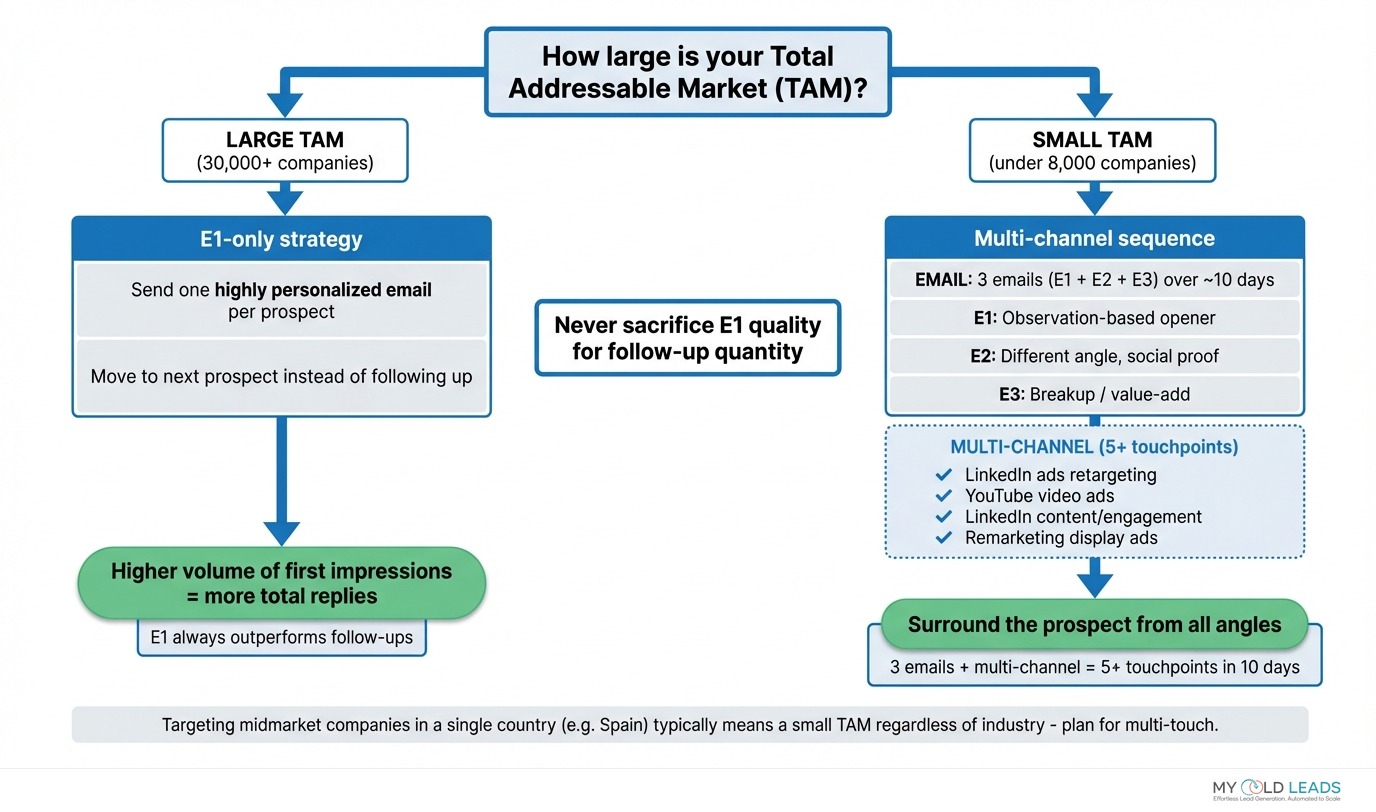
Follow-ups are where strategy matters more than persistence. How many emails you send - and what you put in them - depends entirely on the size of your target market.
Large TAM (30,000+ Companies)
When your total addressable market is huge, keep sending Email 1 on repeat to fresh contacts. Do not build elaborate sequences. Your infrastructure is the bottleneck - mailbox capacity, warmup constraints, daily sending limits. Every email slot you spend on a follow-up is one less new prospect seeing your best-performing message.
E1 always outperforms everything else. In a large market, there is no reason to waste sends on diminishing follow-ups when fresh prospects are waiting.
Small TAM (Under 8,000 Companies)
If you are targeting midmarket companies in a single country like Spain, you are almost certainly in this bracket regardless of industry. You cannot afford to burn through contacts with a single touch. Build a sequence with 0 to 2 follow-ups after E1, and layer in other channels - LinkedIn, phone, even direct mail if the deal size justifies it.
Never send more than two follow-ups. E1 is your initial email. Follow-ups are additional touches after that. So a full sequence is E1 + E2 + E3 at most - three emails total. The data does not support going beyond that. After three touches, you are annoying people, not persuading them.
How Follow-Ups Actually Perform
Here is what we see across our client campaigns:
- E1 is always the top performer
- E2 generates roughly 40 to 50% of E1's reply volume
- E3 varies wildly - sometimes nearly matches E1, sometimes does almost nothing
The secret to a strong E3 is changing the subject line and the angle. If E1 through E3 look like a single email thread, the prospect mentally categorizes it as "that person who already emailed me twice." A fresh subject line resets that perception.
Different CTAs for Each Email
A critical tactic we use: each email in the sequence uses a different type of CTA. If every email asks for the same thing, the prospect tunes out after E1. Varying the ask keeps each touch fresh.
E1 - Value offer: Lead with the core proposition. "We helped [similar company] achieve [result] - happy to walk you through how." Direct, benefit-first.
E2 - Permission-based: Lower the ask. "Would it make sense to explore this, or is [specific topic] not a priority right now?" This gives the prospect an easy out that still signals engagement.
E3 - Lead magnet or redirect: Change the angle completely. Two approaches work:
- The lead magnet: Offer something tangible. "We put together a list of [X] companies that match your ICP - want me to send it over?" The prospect gets value whether or not they take a meeting.
- The redirect: "Who should I speak to about [specific topic]?" This reframes you as someone trying to find the right person. It also sometimes triggers an actual introduction.
We have clients where E3 does almost nothing, and others where it performs nearly as well as E1 precisely because the angle changed completely. The key is that each email feels like a new conversation, not a nagging reminder.
Best Practices and Common Mistakes
After running campaigns across dozens of sectors, patterns emerge. Here is what separates campaigns that generate pipeline from campaigns that burn domains and waste money.
Best Practices
Verify every email address before sending. Bounce rates above 2% are a red flag. And not all bounces are equal - sender bounces (where the sending server rejects your message) are far more damaging than normal bounces (where the recipient address simply does not exist). Sender bounces signal to email providers that your infrastructure is problematic, which accelerates domain degradation. Verification is cheap - bouncing is expensive.
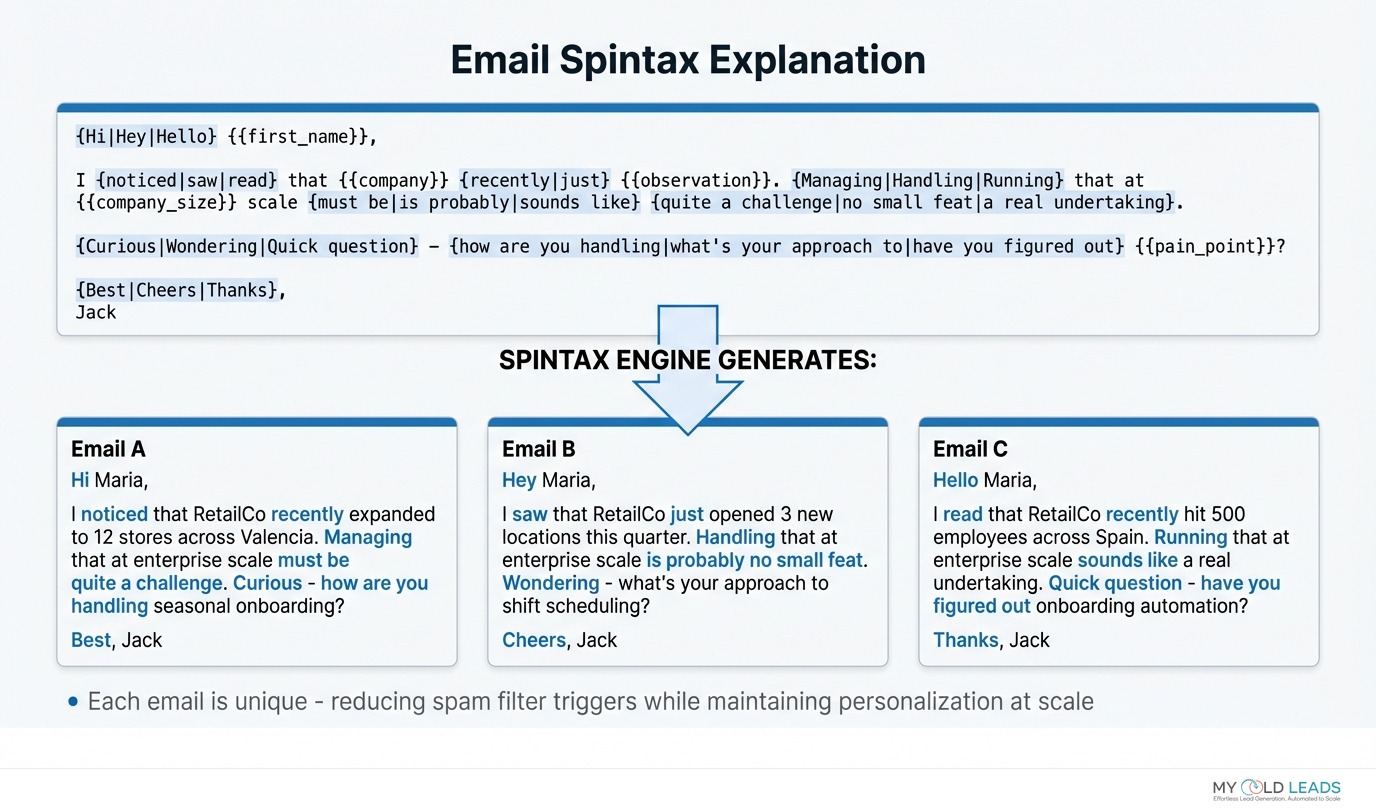
Use spintax for variation. Email providers flag identical messages. Spintax rotates words and phrases so each email reads slightly different while keeping the core message intact. Even small variations - "Hi" vs "Hey", "quick" vs "short" - reduce pattern detection.
A/B test your value propositions, not surface-level elements. You need a minimum of 50 to 60 positive replies per variant before drawing conclusions. Test the core offer first. Optimize subject lines and openers later.
Monitor reply rates daily. Weekly check-ins are not frequent enough. A domain can go from healthy to burnt in 48 hours. Daily monitoring lets you pull back before the damage spreads.
Common Mistakes
1. CTAs that ask for time instead of offering value. "Got 15 minutes?" costs the prospect something. "Let me walk you through how [company] solved this" gives them something.
2. Making it about you instead of them. "We are an award-winning agency that..." - nobody cares. Lead with their world, not yours.
3. Skipping social proof. One sentence about a similar company you helped builds more credibility than three paragraphs about your service.
4. Not reading reply rates as deliverability signals. A drop in replies does not always mean your message is bad. It often means your emails stopped reaching inboxes.
5. Trying to save a burnt domain. If your reply rate plummets, burn the domain immediately. Do not try to save it. You will spend weeks second-guessing every variable when the answer is simple: the domain is done. Domains are disposable - they are not expensive to replace.
6. Sending from your primary domain. We covered this in the infrastructure section. It bears repeating because we still see companies making this mistake.
7. No warmup or insufficient warmup. Two weeks is the minimum. Four weeks is what we prefer. Some clients benefit from two to three months of warmup before launching. Every domain has a different half-life depending on age, provider, and target market. There are no shortcuts here.
Frequently Asked Questions
What is a cold email?
A cold email is a one-to-one outbound email sent to a business contact with no prior relationship. It is not a mass marketing blast. Each message targets a specific person at a specific company based on research that suggests your offer could be relevant to them.
Is cold email spam?
No. Cold email is targeted, personalized, and includes an opt-out mechanism. Spam is untargeted, generic, and sent in bulk with no regard for relevance or recipient preference. The difference is intent, research, and compliance.
What is a good reply rate for cold email?
Per individual email, healthy campaigns see 1.2% to 4% reply rates depending on sector and market. Some roles - like HR Directors - inflate this with out-of-office replies, which we count because they confirm inbox delivery. A full campaign with multiple emails will produce cumulative reply rates of 3 to 12%. Evergreen signal-triggered campaigns - where you reach out based on a real-time event like a funding round or expansion announcement - can hit 15 to 30%. Below 1% per email signals a problem. Above 3% per email means you should scale.
How long should a cold email be?
In English-speaking markets, aim for under 70 words. That constraint forces you to cut every unnecessary word. Spanish-language markets are more lenient - 90 to 100 words works fine. In both cases, shorter tends to outperform longer.
How many follow-ups should you send?
Zero to two follow-ups after your initial email (E1). Large markets - keep sending fresh E1s to new contacts rather than following up. Small markets - build a sequence of E1 plus up to two follow-ups (three emails total maximum). The data does not support going beyond that.
Do cold emails still work in 2026?
Yes. Deliverability has gotten harder as Microsoft and Google tightened enforcement throughout 2025. But reply rates remain strong for campaigns built on proper infrastructure, verified lists, and relevant messaging. The bar is higher - which means poorly executed cold email fails faster, but well-executed campaigns face less competition.